Guide
How to find a good plumber
The reliable signals are a checkable registration, a plumber who asks questions before quoting, and a local address. The unreliable one is who appears first in a search.
Start with the registration, not the reviews
For anything involving gas, the Gas Safe register is the first check and it takes a minute. For an unvented cylinder, ask about G3. For a heat pump, ask about MCS. These are binary facts that either check out or do not, and they are more informative than any number of five star reviews.
Reviews are useful for the things registration does not cover: whether somebody turns up, clears up and answers the phone. Read the three star ones, which are usually the most honest.
Local address, local number
A business with an address you could stand outside and a phone number in the local dialling code is a business that has to live with its reputation in that town. A national number, no address, and a website whose copy names a different town each time you refresh it is a lead broker: they take your details, sell them on, and the person who arrives has no relationship with the brand that answered.
This matters more in plumbing than in most trades, because a large share of the search results for emergency plumbing are lead generation rather than plumbers.
The phone call tells you most of it
A plumber worth booking asks questions before quoting. For a boiler: what is there now, how many bathrooms, what the mains flow is like. For a leak: where the damp is, whether the pressure is dropping, whether it is hot or cold. For a blockage: whether the inspection chamber is full.
Somebody who gives a firm price for a boiler installation over the phone without asking about the water supply is quoting for an appliance and will find out about your house on the day.
Get the scope in writing before comparing prices
Write two or three sentences describing the job and send the same text to everybody you ask. It removes the commonest source of confusion in quotes, which is that each plumber has quoted for a slightly different job, and it gives you something to hold the work against afterwards.
For larger work, ask for one address of a job like yours that they have done. Most will offer it without being asked.
What to do in an emergency, when there is no time for any of this
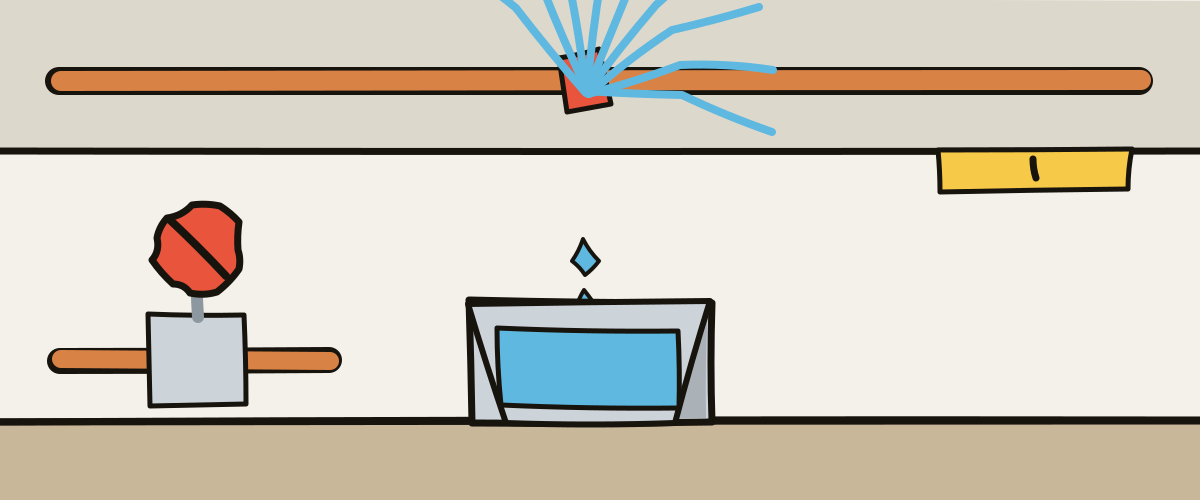
Turn the stopcock off and open the taps. That takes a minute and it changes the problem from an emergency into an urgent booking, which costs roughly half as much and lets you choose who comes.
If it genuinely cannot wait, ask three things on the phone: the charge for the first hour, the rate afterwards, and whether they are Gas Safe registered if a boiler is involved. Write the answers down, because the invoice sometimes remembers differently.
Common questions
How do I avoid a lead generation site?
Look for a local address and a local phone number on the site, and search the business name separately. If the same photographs and copy appear under several different trading names, it is a broker.
Are the big directories worth using?
They are useful for finding candidates. Check whoever you find against the Gas Safe register yourself rather than relying on a badge on a profile.
Should I use the cheapest quote?
Only when the quotes cover the same scope. A cheaper quote that excludes making good, disposal and a seized valve allowance is usually not cheaper by the time the invoice arrives.